
Arkansa
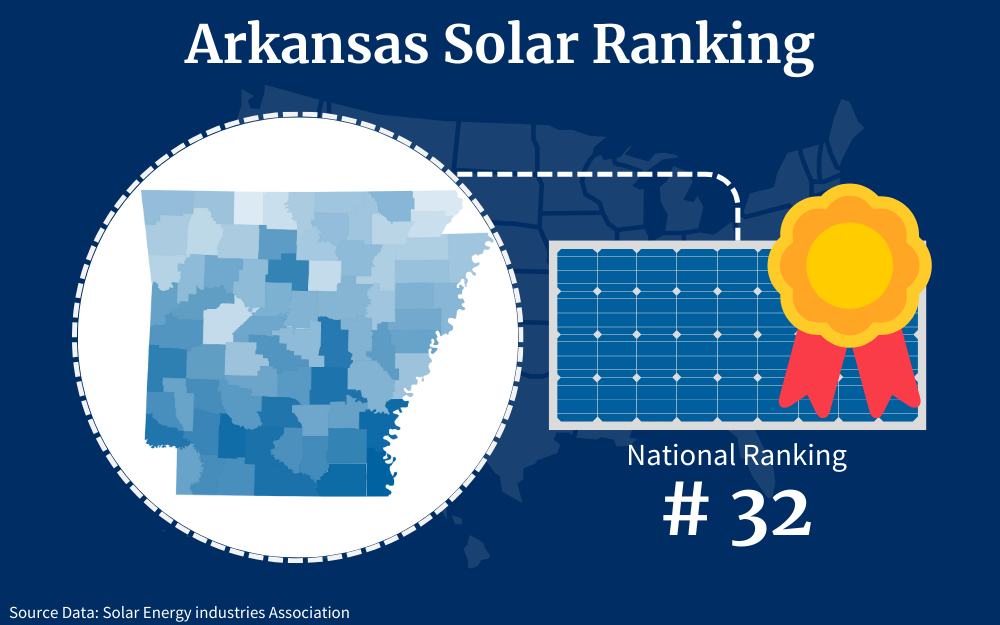
Arkansas’s solar market has been growing rapidly in capacity and investment, with installed solar reaching about 2,954 MW by mid-2025, enough to power over 339,000 homes, and ranking 19th nationally in total capacity. The state’s solar market has attracted ~$3.8 billion in investment and supports hundreds of jobs, though solar still comprises a minority share of total power generation. National industry projections anticipate more than 3,000 MW of additional solar capacity growth over the next five years in Arkansas.
From a land-use and local impact perspective, utility-scale solar deployments are expanding but remain modest relative to agricultural footprint: by 2026, solar arrays are projected in 15 counties across the state, occupying only ~0.2 % of Arkansas’s 13.7 million acres of farmland under current projections, and under 1 % even under extreme growth scenarios. This data implies that commercial solar does not present a significant threat to core agricultural land use, easing one common stakeholder concern.
Regulatory and compensation policies have shifted recently: Arkansas revised its net-metering framework, where traditional 1:1 retail credits for export to the grid are phased out or altered in favor of alternative compensation structures, and commercial net-metering limits remain modest (e.g., 300 kW capacity limit under older rules, with grandfathering provisions for legacy agreements). These changes materially affect the economics of commercial and distributed generation projects, meaning ROI models must more heavily weigh avoided cost credits, interconnection costs, and federal incentives like the Investment Tax Credit (ITC).
State official’s stance on commercial wind power development is characterized by cautious progression on existing projects coupled with robust new regulatory constraints that make future development far more difficult. In late **2025 the Arkansas General Assembly enacted the Arkansas Wind Energy Development Act (Senate Bill 437, also known as Act 945), a legislative framework that requires utility-scale wind energy projects to meet a series of stringent siting, setback, environmental review, and permitting standards before they can proceed. Under this law, turbines must be set back at least 3.5 times their height or a minimum of 2,500 feet from nonparticipating landowners’ property lines and at least 1 mile from schools, hospitals, parks, airports, nursing homes, churches, city limits and similar public places; the rules also call for environmental evaluations, public participation, and decommissioning financial assurances. These restrictions, backed by the legislature and now being implemented through Public Service Commission rules, are widely regarded — including by industry advocates — as stringent enough that they create a de facto moratorium on most new commercial wind farm development in the state.
Despite these limits, Arkansas has already seen noteworthy progress with its first utility-scale wind farm, the 135 MW Crossover Wind project in Cross County, which began commercial operations in late 2025. This project, developed by Cordelio Power, supplies electricity under a long-term power purchase agreement and is expected to contribute roughly $950,000 annually to the county and more than $50 million to local landowners over its lifetime, demonstrating tangible economic value for host communities.
Local policy responses illustrate wider divisions across the state: several counties in northwest and northern Arkansas — including Crawford, Carroll, Madison, Boone, and Newton — have adopted moratoriums or bans on new commercial wind farm construction, often citing concerns about impacts on landscapes, property values, and rural character. Other counties, such as Searcy County, have rejected moratoriums, instead opting to align local regulation with state law and allow projects that comply with the new statutory requirements to move forward.
Taken together, these developments show that while Arkansas is not outright banning commercial wind power, its legislative and local regulatory environment in 2026 favors heavy oversight and limitations on new projects, with only a narrow window for projects that were already underway or can meet the new siting standards to be approved and built.
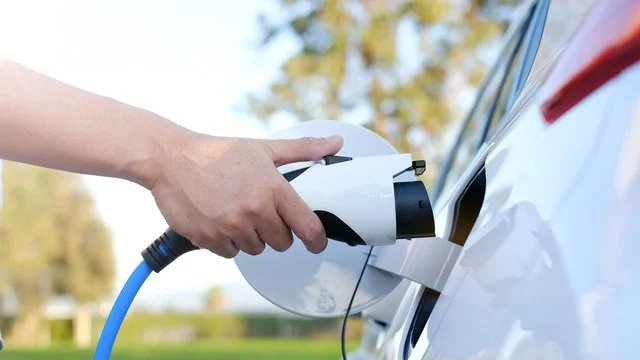
As of 2026, Arkansas’s stance toward commercial EV charging station projects reflects both active support through federal and state funding and real-world deployment data showing how that support has translated into infrastructure. Under the National Electric Vehicle Infrastructure (NEVI) Formula Program, Arkansas was allocated roughly $54.1 million in federal funds from 2022–2026 to build out EV charging stations along federally designated Alternative Fuel Corridors and interstates. These funds are disbursed on a competitive reimbursement basis covering up to 80 % of project costs with the remaining share typically provided by private partners, utilities, or other sources, and projects must be publicly accessible and NEVI-compliant.
In terms of on-the-ground charging infrastructure, the state has seen measurable growth in public stations over the past few years. According to recent data, Arkansas has around 378–380 public charging stations statewide with 1,055+ public charging ports, including both Level 2 and DC fast chargers; most chargers are Level 2, with a smaller number of fast charging stations suitable for longer-distance travel. The Alternative Fuels Data Center also reports over 1,000 total electric charging ports in Arkansas, indicating broader availability of alternative fuel infrastructure. This infrastructure has expanded significantly from earlier years (for example, plans from past years reported roughly 171–300 public charging locations with fewer ports), illustrating growth in response to state and federal incentives.
State and utility incentives further underline Arkansas’s supportive stance. Beyond NEVI, the Arkansas Department of Energy & Environment (ADEQ) has historically offered rebates for Level 2 and DC fast charging installations, and utilities such as Entergy Arkansas provide additional rebates and funding for commercial charging projects, helping to offset costs for businesses and other non-government proponents. However, it’s important to note that in early 2026 the NEVI deployment program underwent a federal suspension and revision of guidance, leading the ARDOT to close the current request for proposals and pause new federal obligations until updated NEVI guidance is issued. This reflects the evolving federal-state framework that shapes how commercial EV charging projects proceed in Arkansas.