

Illinois
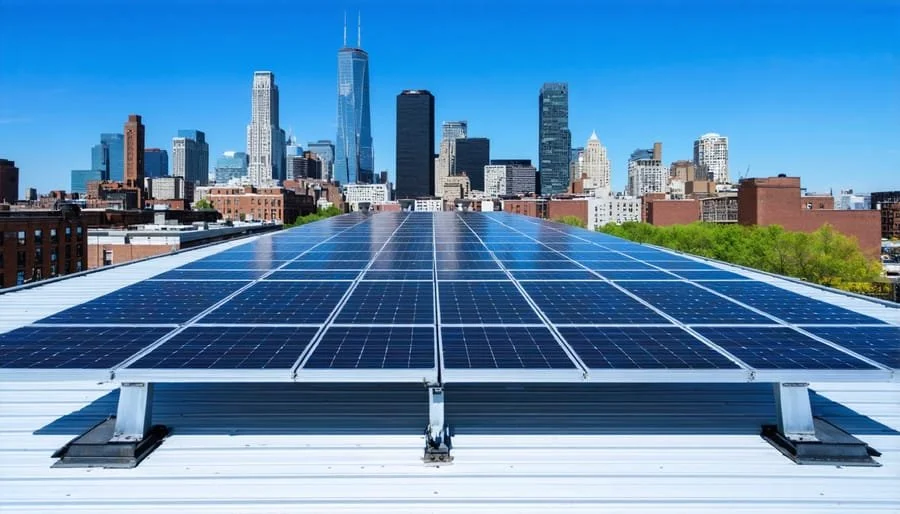
Illinois is actively planning to expand and structure its support for commercial and larger solar panel projects through 2026 and beyond by building on its existing state programs and multi‑year procurement plans. Central to this effort is the Illinois Shines program, a distributed solar and community solar incentive framework that allows businesses and developers to earn payments for Renewable Energy Credits (RECs) produced by their solar installations; these credits are sold to utilities to help meet Illinois’s Renewable Portfolio Standard and provide revenue to project owners. The state’s 2026 Long‑Term Renewable Resources Procurement Plan, filed by the Illinois Power Agency (IPA) with the Illinois Commerce Commission (ICC), lays out goals for the next two program years (2026‑27 and 2027‑28) and proposes specific capacity targets for Illinois Shines — for example, allocating about 1,000 MW of program capacity in 2026‑27 and 800 MW in 2027‑28 — along with updated REC pricing and refinements to support more equitable participation by firms representing historically underserved communities.
Beyond Illinois Shines, the IPA’s long‑term plan also includes procurement targets for utility‑scale solar RECs and self‑direct opportunities for large commercial customers who contract with new solar facilities and retire RECs to reduce Renewable Portfolio Standard charges. Concurrently, the state’s Illinois Solar for All initiative continues to support community solar and nonprofit‑oriented projects that, while not strictly profit‑driven commercial ventures, help expand solar capacity and program participation across broader segments of the economy and workforce.
The overarching objective of these plans is to provide long-term certainty and structured market signals for investors and developers so that commercial solar projects can be planned, financed, and built with knowledge of expected incentive availability and REC procurement outcomes. The IPA anticipates a final order from the ICC on the 2026 Long‑Term Plan in early 2026, after which the finalized program details will take effect and guide solar deployment strategies for Illinois into the later 2020s.
If your company is interested, our team would love to help explore some of these opportunities and develop an in-depth proposal tailored exactly to your needs, outlining the most beneficial programs, financial incentives, and project options for your business.
As of 2026 and looking forward, Illinois maintains a strong policy stance in favor of expanding wind power generation as a key part of its broader clean energy and decarbonization strategy. Under the state’s major climate law, the Climate and Equitable Jobs Act (CEJA), Illinois has established legally binding renewable energy targets that require increasing amounts of electricity to come from renewable sources, with the goal of reaching 40 % renewable energy by 2030 and 50 % by 2040, and ultimately moving toward 100 % clean energy by 2050; wind generation is expected to be a major contributor to these targets. The Illinois Power Agency (IPA) and the Illinois Commerce Commission (ICC) are actively implementing long‑term renewable procurement plans that include substantial wind power components, with recent procurement cycles approving over 1.1 GW of new utility‑scale wind projects to support growth in renewable capacity. In addition, current planning documents filed by the IPA for 2026 and beyond set out procurement targets for wind and other renewables through annual Renewable Energy Credit (REC) programs, reflecting continued commitment to contracting and building out wind resources statewide.
Economically, Illinois is already among the top states in the nation for installed wind energy capacity, with more than 10 GW of wind capacity spread across nearly 100 projects producing approximately 10–12 % of the state’s electricity, enough to power over a million homes. The policy environment also includes programs like the Self‑Direct Renewable Portfolio Standard Compliance Program, which allows large electricity users to meet part of their clean energy obligations through direct contracts with wind and other renewable generators, providing financial incentives to support wind development under CEJA. Meanwhile, regulatory planning such as the Renewable Energy Access Plan (REAP) has been developed to identify favorable zones for renewable siting and improve transmission access to those wind generation areas, a recognition that expanding wind capacity must be complemented by adequate grid infrastructure.
At the same time, there is ongoing political debate in Illinois about the pace and balance of energy policy. Some lawmakers have raised concerns about potential electricity shortfalls by 2030 due to rapidly increasing demand (for instance, from data centers) and argue that renewable expansion, including wind, should be balanced with more reliable traditional generation sources such as natural gas and nuclear. Nonetheless, the overarching direction of state policy remains supportive of wind power as a pillar of Illinois’ transition to a clean energy future, with continued procurement actions, capacity growth, and planning mechanisms aimed at expanding wind generation well into the 2030s and beyond.

Electric vehicle (EV) charging stations in Illinois deliver tangible benefits across environmental, economic, and mobility fronts. Public charging infrastructure reduces emissions from transportation — the state’s largest source of air pollution — by making EV ownership more practical and helping cleaner vehicles replace internal‑combustion cars and trucks, which improves air quality and public health. Expanding charging access also supports consumer confidence and convenience, with a mix of Level 2 and DC fast chargers becoming more common in urban areas, along major highways, and in public facilities, enabling drivers to recharge quickly and reliably on both short trips and long-distance travel. Robust charging networks also help drive broader grid resilience and smart energy integration as utilities upgrade infrastructure and implement charging programs that smooth demand and support renewable energy use.
The State of Illinois has laid out a clear strategy to scale EV charging station deployment in alignment with its goal of having 1 million EVs on the road by 2030. Through programs like the National Electric Vehicle Infrastructure (NEVI) Program, Illinois is using federal funds to build fast chargers spaced approximately every 50 miles along interstate corridors and to support additional build-out statewide, while separate grants and incentives help expand community and freight charging locations. The Illinois Environmental Protection Agency and Department of Transportation regularly award funding for new EV charging sites, and utilities offer make‑ready rebates and other support to reduce installation costs for businesses and public entities. In addition, state incentives — including rebates for charging station installation and collaboration on Midwest electrification initiatives — further strengthen Illinois’s EV ecosystem.
We’d like to invite you to explore how your organization can strategically prepare for and benefit from this transformative shift in transportation infrastructure. Our team specializes in consulting on EV charging deployment strategies, funding navigation, incentive optimization, and integration planning suited to public, private, and mixed‑use settings. Please join us for a consultation to discuss tailored solutions that align with Illinois’s evolving EV landscape and support your goals in this rapidly growing market.